Unlocking Young Minds: The Complete Guide to Shikaku Puzzles for Children Aged 12 and Under
Picture a puzzle that blends the spatial thrill of Tetris with the logical demands of Sudoku, yet remains gentle enough for a six-year-old to solve with a proud smile. That puzzle exists, and it is called Shikaku. Sometimes known as "Divide by Squares" or "Rectangles," Shikaku is a Japanese logic puzzle that is rapidly gaining recognition among parents, educators, and puzzle enthusiasts as one of the most effective and genuinely enjoyable brain-training tools for young children. Whether you are a homeschooling parent seeking screen-free activities or an entrepreneur looking for the perfect low-content book interior to publish on Amazon KDP, understanding the depth of Shikaku puzzles offers immense value.
What Exactly is a Shikaku Puzzle?
To build a strong foundation, we must start with the mechanics. A Shikaku grid presents a seemingly empty or sparsely marked field, usually rectangular, with numbers dotted throughout the cells. The objective is deceptively simple: divide the entire grid into rectangles (and squares) such that every single rectangle contains exactly one number. That number must equal the area of the rectangle that contains it. So, a cell marked with a '6' must be the only number inside a rectangle composed of exactly 6 individual cells (for example, a 2x3 or 1x6 block). A cell marked with a '1' stands alone as a 1x1 square. The rectangles cannot overlap, and no grid space can be left empty.
Unlike many number puzzles, Shikaku does not require arithmetic calculations during the solving process. It relies purely on spatial reasoning, multiplication factoring, and geometric logic. For a child, this transforms math from an abstract memorization chore into a tactile, visual, and deeply satisfying construction project.
Why Shikaku Puzzles Are a Perfect Fit for Young Brains
Modern neuroscience emphasizes the critical importance of developing spatial intelligence during the early years. Spatial reasoning—the capacity to understand, reason, and remember the visual relations among objects—is a robust predictor of future achievement in science, technology, engineering, and mathematics (STEM). Shikaku acts as a gymnasium for this specific cognitive muscle. When a child analyzes a '12' on a grid and mentally tests whether a 3x4 or a 2x6 rectangle fits without colliding with neighboring numbers, their brain is forging new neural pathways.
From Abstract Multiplication to Visual Mastery
One of the most common struggles for children in traditional education is the disconnect between a multiplication table and its real-world application. A child might memorize that "four times three equals twelve," but still struggle to visualize what that actually means. By drawing a 4x3 rectangle to cover a '12' in a Shikaku puzzle, the concept of area becomes physical. The grid cell is the physical proof of the equation. This is the heart of kinesthetic and visual learning, and it frequently triggers the "aha!" moment that rote memorization fails to deliver.
Building Executive Function and Strategy
Shikaku is not a guessing game. It rewards systematic thinking. Experienced solvers teach children to look for the "big numbers" first or to lock off "forced" rectangles. For example, a prime number like a '7' on the border of a grid immediately forces a 1x7 rectangle because 7 cannot be factored in any other way. Learning to identify these constraints trains a child's executive functions: planning, impulse control, and cognitive flexibility. They learn that rushing leads to contradictions, while patience and strategy lead to the triumphant completion of a clean grid of blocks.
The KDP Interior: A Game-Changer for Low-Content Publishing
Shifting from the educational landscape to the business landscape, the demand for high-quality puzzle books on Amazon Kindle Direct Publishing (KDP) has exploded. Parents are actively seeking screen-free activities that combat boredom without defaulting to video games. Shikaku puzzles fill a unique niche here because they are not as saturated as word searches or standard Sudoku. However, creating a print-ready puzzle book from scratch is a technical headache. This is where a professionally formatted KDP interior becomes an invaluable asset.
Why "Print-Ready" Matters
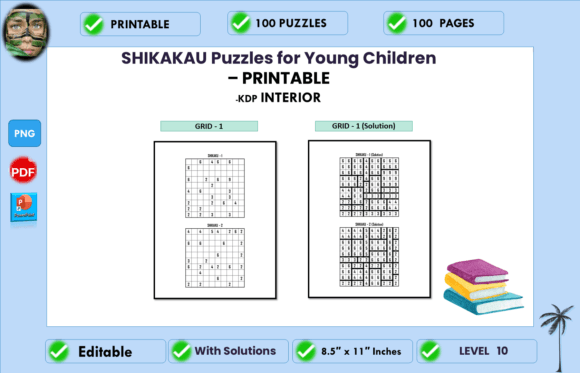
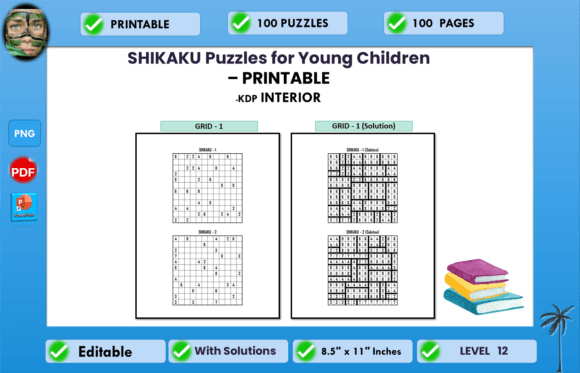
When you purchase a product described as a "KDP Interior," you are bypassing the most labor-intensive phase of book creation. The hard work of defining margins, aligning grids, ensuring no-bleed specifications, and testing the solutions is already done. Specifically, an interior sized at 8.5 x 11 inches with no bleed is the industry standard for activity books for children. At this large size, the grids are spacious enough for small hands that are still developing their pencil grip and fine motor skills. There are no cramped cells that cause visual strain or frustration.
The Advantages of a 100-Page Editable Format
Imagine receiving a package that contains 100 meticulously crafted Shikaku puzzles, perfectly formatted, and tested for Amazon's strict printing requirements. The "100 pages" structure strikes the perfect balance between value and thickness. A book of this length is substantial enough to keep a child engaged for weeks—perhaps during long car rides, quiet afternoons, or as a daily brain warm-up—yet thin enough to remain lightweight and easy to handle for young children. The inclusion of editable source files (often in PPT format) is a massive strategic advantage for a publisher. While the PDF is ready to upload immediately for passive income, the PowerPoint file allows you to inject your own branding. You can add a unique title page, a "This Book Belongs To" page, or a custom completion certificate at the back to differentiate your brand from competitors using the same raw interior.
Inside the Design: Technical Excellence for Young Users
Creating puzzles for children aged 12 and under requires a meticulous balance of challenge and accessibility. A well-designed interior doesn't just throw 100 puzzles at a wall; it sequences them intelligently. The journey typically begins with small grids—perhaps 5x5 or 7x7—using numbers only up to 10. This allows a 5-year-old to tackle the early challenges by focusing purely on the visual pieces. As the pages turn, the grids expand gradually, introducing larger numbers and more complex interlocking shapes. This scaffolding ensures the child's confidence grows in lockstep with their ability.
The Critical Role of Solutions
Anyone who has handed a puzzle to a frustrated child knows that the solution section is non-negotiable. An interior labeled "With Solution" isn't just a bonus; it is a pedagogical necessity. The ability to flip to the back of the book and check an answer transforms the experience from a high-stakes test into a low-stakes learning loop. If a child's rectangle doesn't match the solution, it becomes a logic lesson, not a failure. They can retrace their steps and debug their spatial reasoning. For the seller, complete solution sets also dramatically reduce negative reviews on Amazon. A parent who cannot help their child solve a puzzle because no answer key exists is a parent who leaves poor feedback.
High-Resolution and Print Compatibility
The terminology "high-resolution interiors" might sound like technical jargon, but it correlates directly to a child's experience. Low-resolution images result in fuzzy, pixelated grid lines that look unprofessional and make it difficult to distinguish the boundaries of a number cell. A crisp, high-resolution vector or 300 DPI print-ready file ensures that the ink on the paper holds sharp, clean lines. This clarity signals to the child that this is a "real" book, not a cheap printout, boosting their engagement and the parent's perceived value of the purchase.
Dispelling Common Misunderstandings About Shikaku
Because Shikaku is less mainstream, new users often harbor a few misconceptions. The most common is that it is "just for math geniuses." This is profoundly false. The beauty of Shikaku lies in its visual nature. A child with dyslexia or dyscalculia who might struggle with traditional numerical notation often excels at Shikaku because they can "see" the answers in the shapes. They are partitioning space, not calculating arithmetic. Another misunderstanding is that the puzzle is solved by coloring. While coloring the rectangles is fun and encouraged for engagement, a single pencil line dividing the grid is technically all that is required to solve it. This distinction frees the child from perfectionism—they don't need a perfectly shaded block, just a clear boundary line.
Shikaku vs. Other Grid Puzzles
Parents sometimes confuse Shikaku with similar Japanese logic games. It is not Nonograms (which create pixel art) or Hashiwokakero (bridges). Shikaku's focus on area and rectangles makes it uniquely accessible to the youngest solvers. It requires no pre-existing math vocabulary like "sum" or "product"—just the concept of "how big is this space?" This makes it arguably the best entry point into the world of logic puzzles for children who have outgrown simple mazes but find Sudoku too abstract.
Integrating Shikaku into Daily Life and Education
For the modern parent or teacher attempting to reduce screen time, the ready-to-print Shikaku interior offers a lifeline. You are not just buying a PDF; you are acquiring a hardware-free behavioral tool. These puzzles can be printed on demand. A teacher who spots a student finishing their math work early can walk to the printer, select pages 34 and 35, and hand the child a fresh intellectual challenge that reinforces the day's lesson on area without a single worksheet-look repetition.
Furthermore, the social value should not be underestimated. Although puzzles are often solitary, Shikaku fosters collaboration. Siblings can work together, arguing constructively over whether the 8-block should go horizontal or vertical, learning to verbalize geometric logic. The large 8.5" x 11" format is big enough for two children to hover over the same page, pointing and tracing potential lines with their fingers. It becomes a shared language of shapes.
Why This Interior Is a Smart Foundation for Your Business
From a strictly entrepreneurial standpoint, low-content publishing hinges on volume and distinction. The marketplace is flooded with blank journals. An activity book that is mentally stimulating, age-appropriate, and visually clean stands out immediately. By starting with a sourced interior that offers 100 pages of solved, formatted puzzles, you collapse your production time from months to minutes. The availability of PDF, PPT, and PNG formats offers ultimate flexibility. The PDF is your direct-to-KDP moneymaker. The PNG files allow you to extract individual puzzle images for social media marketing, showing parents exactly the type of clear, uncluttered puzzle their child will receive. The editable PPT allows you to localize the instructions, perhaps translating them into Spanish, French, or German to access non-English markets with relatively low competition.
Remember that with no-bleed formatting, you don't need to worry about trimming errors by Amazon's printing presses. The content sits safely within the margins, giving you a reliable, low-hassle product. The effort required to produce "100 tested for KDP" puzzles from scratch is massive, involving iterative solving, symmetry checking, and ensuring solution uniqueness. By leveraging a ready-made interior, you are cashing in on the cognitive science of play without wading through the technical weeds.
Ultimately, Shikaku represents a convergence of fun and cognitive development that is rare in the children's activity book world. It respects the intelligence of the child. It doesn't talk down to them with overly cute distractions; it presents a clean, elegant logic challenge and trusts the child to rise to meet it. Whether you hand a printout to a 7-year-old to keep them quiet on a rainy Sunday, or upload a fully branded book to capture the Amazon children's puzzle category, the core value remains the same: you are giving a young brain the tools to visualize, reason, and succeed. The high-resolution, ready-to-print interior simply makes that gift effortless to deliver, and that is a narrative both children and algorithm-driven search engines will appreciate.