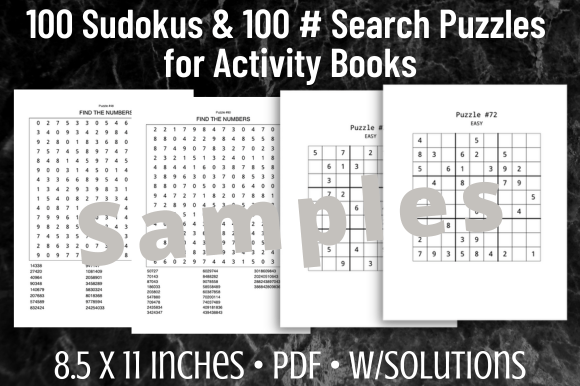
100 Number Search 100 Sudoku Puzzles for KDP Books
Building a brand around activity books on Amazon KDP often comes down to two critical factors: how much creative control you have over the interior design, and how much time you can realistically invest before a title goes live. The 100 Number Search 100 Sudoku Puzzles bundle tackles both. It gives you a ready-to-edit collection of puzzle interiors that fit the standard 8.5 x 11 inch format with no-bleed, meaning you spend less time wrestling with layout quirks and more time shaping a cohesive book that speaks to your audience. Whether you assemble a pure number puzzle book or mix and match these with coloring pages, mazes, or journaling prompts, the bundle acts as a modular toolkit for publishers who value speed and originality.
What sets this apart from a handful of randomly downloaded puzzle sheets is the intentional pairing of two highly popular formats. Number search puzzles and sudoku each have dedicated followings, and combining them in one volume increases the perceived value for buyers. If you have ever faced the challenge of creating variety without cluttering a book’s identity, having exactly 100 of each type helps you structure a balanced interior. You can, for instance, alternate between a number search puzzle and a sudoku throughout the book, or group all sudoku in the first half and all number searches in the second. The format encourages strategic arrangement rather than a rigid one-size-fits-all progression.
How Puzzle Interiors Simplify the Publishing Workflow
For independent publishers, formatting puzzle books from scratch can become a roadblock. Aligning grids, checking that solution pages follow the same margin rules, and ensuring print-ready dimensions can eat up days of trial and error. The 100 Number Search 100 Sudoku Puzzles bundle addresses that directly by delivering PDF files already set for 8.5 x 11 inches with no-bleed. When you open a file, the puzzle sits comfortably within the trim area, so you won’t find cut-off numbers near the edges after printing. This kind of consistency may sound minor, but it directly influences customer reviews, especially when buyers leave feedback about “poor print quality” that is actually a layout oversight.
Because each puzzle product comes as its own PDF, you aren’t locked into one combined file. You can select the 50 sudoku puzzles that fit your difficulty curve, pull all 100 number searches, or grab only the harder or easier variants. This level of selective assembly means the same bundle can serve vastly different target audiences—from seniors looking for gentle mental exercise to puzzle enthusiasts who want hours of frustration-free concentration.
Cutting Down Production Time for KDP Creators
One of the most practical outcomes of using pre-structured puzzle interiors is the reduction in repetitive admin work. Instead of designing grids, typing in digits, and separately formatting answer keys, you work with pre-solved puzzles where solutions are already included. This cuts out the most labour-intensive part of activity book creation. Many experienced KDP creators note that after the creative concept phase, the bulk of time drains away on manual formatting. A bundle like this, where you receive PDF files that can be modified with a converter, shifts that balance dramatically.
Consider a common scenario: you plan to release a series of travel-sized puzzle books over the next three months. With the 100 Number Search 100 Sudoku Puzzles interiors, you can duplicate the original files, adjust puzzle selection, reorder pages, and export a new manuscript in the same afternoon. You don’t have to rebuild anything from zero. That kind of iteration speed matters when you want to test multiple book titles, cover designs, or pricing tiers without committing to heavy upfront work for each variant.
Creative Mixing and Matching for Unique Book Identities
The instruction to “mix and match them to make your own unique content activity books” deserves careful attention. Activity book buyers are increasingly savvy. They recognize recycled content across different books, and a generic compilation can struggle to stand out in search results. By treating these puzzle interiors as raw components, you retain the freedom to combine them with other interactive elements—word searches, kakuro, logic riddles, or even blank dot grid pages for note-taking. A book that pairs 50 number searches with 30 large-print sudoku and 20 coloring pages, for example, occupies a niche that a single-puzzle book cannot.
This is especially relevant if you target a demographic that values cognitive variety. Seniors, for instance, often appreciate a mix of number-based and word-based puzzles to avoid mental fatigue from the same task. Younger puzzle fans, on the other hand, might be drawn to books that layer number searches with trivia or fun facts in the margins. Because the 100 Number Search 100 Sudoku Puzzles bundle does not dictate the final structure, you can build these hybrid formats without needing separate design tools for each puzzle type.
Professional Results Without a Design Background
Publishers who don’t come from graphic design often find that creating a visually clean puzzle page requires more effort than expected. Margins shift when pages are mirrored or scaled, number grids can look cramped if font choices aren’t tested, and solution pages need to be distinct from the puzzle without feeling disconnected. The no-bleed 8.5 x 11 inch specifications in this bundle solve a lot of those headaches before they occur. Because the files are designed for standard trim, you can place them directly into your book without adjusting inner margins, provided your overall document settings match.
Additionally, the fact that you can modify the PDFs using a converter opens up subtle branding possibilities. You might add a small footer with your author name, page numbers, or a subtle logo without redesigning the puzzle itself. This keeps your brand consistent across multiple books while the puzzle work remains untouched. When you browse top-performing puzzle books on Amazon, you will often notice that the difference between a generic interior and a polished one lies in these small but deliberate customization touches.
Keeping the Original Files Safe for Reuse
There is a small but vital operational practice hidden in the guidance to “make a duplicate copy to work with so you can keep the original file as is for future use.” In the rush of creating a new publication, it is tempting to edit the only copy you have. Doing that, however, means you lose the untouched puzzle set for your next project. By duplicating the PDFs first, you preserve a clean master that can be leveraged again with a different puzzle order, a new mix of supplementary material, or a completely altered difficulty structure. Over time, this habit alone can save you from repurchasing or recreating similar puzzle content.
This approach is particularly useful if you intend to build a puzzle brand. Let’s say you release a Brain Teasers for Adults volume one with 100 sudoku and 100 number searches. Six months later, your reviews show that customers prefer harder sudoku but love the number searches exactly as they are. With the original files still intact, you can extract only the number search PDF, pair it with a new set of advanced sudoku from another source, and launch a fresh book that matches reader demand—without starting over.
Who Stands to Benefit Most from These Puzzle Interiors
While the puzzles are suitable for all ages, the most immediate beneficiaries are KDP publishers and content entrepreneurs who want to scale their activity book production. If you already have a storefront with coloring books, journals, or educational workbooks, adding puzzle titles can diversify your catalogue and attract a different subset of Amazon shoppers. Puzzle books also tend to have steady demand that isn’t heavily tied to seasonal trends, making them reliable backlist earners.
Educators and homeschool parents may also find value in using these puzzles as supplementary material. A teacher could take a handful of number searches to reinforce number recognition or pattern detection, while sudoku puzzles can support logical reasoning practice. The 100 Number Search 100 Sudoku Puzzles format, with solutions included, allows for quick printing of classroom sets without worrying about formatting errors.
Freelancers who offer interior design services for clients can also use the bundle as a base. Instead of creating puzzle layouts from scratch for every new order, they can adapt these ready-made files to match a client’s branding, drastically reducing turnaround time while delivering a professional result.
Possible Limitations and Fit Considerations
No single puzzle bundle fits every publishing goal, and it is worth recognising a couple of areas where you might need to evaluate whether these interiors match your project. The first is software compatibility. While PDF converters can extract and modify content, not all free tools handle PDF editing equally well. If your workflow relies on a specific vector-based design program, you may need to test whether the converted files retain grid alignment and font clarity to your satisfaction. A small time investment in testing the first few puzzles can prevent scaling issues later.
The second consideration is difficulty targeting. If you want to market a book specifically at absolute beginners or at expert-level fans, you’ll likely need to supplement the existing puzzles with additional graded content. The bundle provides 100 sudoku and 100 number searches, but it doesn’t explicitly sort them by difficulty tiers, so you may need to spend some time categorising them yourself if tiered progression is central to your book’s promise. That said, many successful puzzle books use a gentle mix of easy and moderate challenges without strict levelling, and buyers often appreciate the informal flow.
Another aspect to weigh is the niche overlap. Since these puzzle interiors are digital products available to multiple publishers, it’s your responsibility to differentiate the final book through arrangement, added content, cover design, and title identity. A publisher who simply uploads the raw PDF as-is may face more direct competition than someone who adds meaningful customisation. The bundle works best as a canvas, not the final painting.
Building Hybrid Activity Books That Reflect Reader Interests
One of the most effective ways to use the 100 Number Search 100 Sudoku Puzzles interiors is by combining them with thematic content that already resonates with your target audience. Suppose your readers enjoy mindfulness and relaxation activities. You could intersperse sudoku pages with guided breathing exercises or mandala coloring sheets. If your niche is brain training for seniors, you might add memory tip inserts and large-print number searches from this bundle alongside other mental agility puzzles. The goal is not to force-fit every included puzzle into one book, but to create a curated experience where the number puzzles feel like a natural extension of the overall theme.
Because the bundle includes both word search puzzles and number-based games, the potential for thematic blending is broad. You could create a camping-themed puzzle book where number searches contain nature-related number sequences (by adding custom clues), while sudoku pages are interspersed with backpacking trivia. That level of thematic integration is what turns a generic puzzle compilation into a memorable product that earns repeat buyers.
Making the Most of Solution Sections
Providing complete solutions is not just a convenience feature; it upgrades buyer confidence. When a customer flips through the “Look Inside” feature on Amazon and sees clear answer keys at the back, it signals that the book respects their time and doesn’t expect them to struggle indefinitely. In the 100 Number Search 100 Sudoku Puzzles bundle, solutions are already integrated, so you don’t have to create separate answer pages. However, you can still enhance them by adding a short note at the start of the solution section, perhaps encouraging users to attempt the puzzle first or highlighting that all answers are verified.
Some publishers use the solution section as an opportunity for engagement: they may add a subscriber link to a puzzle newsletter, offer a bonus digital download, or simply include a friendly message. Because the PDFs are editable, you can layer in these details without altering the solved grids themselves.
Strategic Ordering for a Satisfying User Journey
How you arrange the puzzles across the book impacts how the reader feels as they progress. Placing a few easier sudoku at the beginning builds momentum. Introducing number searches after every ten or fifteen sudoku pages breaks up the monotony and keeps mental fatigue low. With 100 of each puzzle type, you can craft a rhythm that feels intentional. For a large print edition, you might keep each puzzle on a separate page and use generous spacing, since the interior is already set for 8.5 x 11 inches with no-bleed. Seniors, in particular, appreciate not having to squint at cramped numbers.
You could also segment the book into chapters, each with a small intro that explains the puzzle’s benefits or gives a quick tip. Because you are not locked into one fixed order, you can experiment with multiple versions for different formats—paperback, hardcover, or even spiral-bound if you use a third-party printing service—without redesigning any puzzle from scratch.
Expanding Your Puzzle Empire with Minimal Overhead
The reality of KDP publishing is that while the marketplace is crowded, consistent output and catalog depth still drive visibility. By using the 100 Number Search 100 Sudoku Puzzles interior bundle, you can produce a series of books that share a similar structure but target distinct sub-audiences. One month, you publish a “Road Trip Puzzle Collection” that heavily features number searches alongside car-themed word games. Another month, you release a “Coffee Break Sudoku” volume with mostly sudoku and a handful of number searches for variety. Each book shares the same puzzle core, yet the outer packaging and supplementary materials differentiate them enough to avoid mutual cannibalisation.
This model works particularly well when combined with your own original content. If you are already skilled at creating word searches, you could use the sudoku from this bundle to offer a complete 2-in-1 book without having to learn sudoku construction yourself. Similarly, if you design your own crossword puzzles, adding the number searches from this bundle allows you to quickly assemble a multi-format puzzle book that feels rich and varied to the end user.
In a discipline where margins often depend on efficient asset reuse, having a digital reservoir of 200 puzzles that you can reorder, repurpose, and re-release across different titles is a resource that aligns with both creative and commercial goals.