Basketball Playbook – KDP Interior: A Practical Guide for Low-Content Publishers
Finding the right interior file can make or break a low-content publishing project. For many KDP sellers, the search for a well-structured, print-ready template leads to options like the Basketball Playbook – KDP Interior. This resource is a ready-to-upload PDF with 110 pages, formatted at 6 by 9 inches and set up with bleed, targeting authors who want to create a basketball-themed notebook or playbook without designing the layout from scratch. Understanding what this product offers, how it compares with alternatives, and when it fits your publishing strategy helps you decide whether it’s the right tool for your next Amazon KDP title.
What the Basketball Playbook – KDP Interior Actually Provides
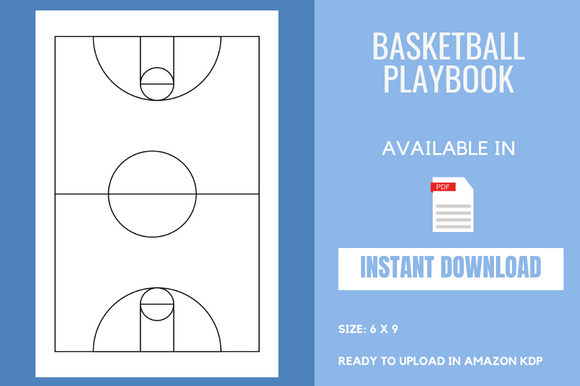
At its core, this interior is a pre-designed document that gives you a structured canvas for a basketball playbook. Rather than a blank notebook, it includes formatted pages intended for drawing court diagrams, writing plays, or logging team strategies. Since the file is delivered as a PDF, you don’t need to worry about margin setups, page numbering, or vector-based court outlines—the technical layout work is done. The 6×9 trim size is standard for many trade paperbacks, so the printed book feels familiar in hand, and the inclusion of bleed means that any background elements that extend to the edge of the page won’t cause white slivers when trimmed—an important detail for KDP print approval.
For those unfamiliar with bleed, it’s the area that allows ink to run past the trim line. Without it, designs that reach the page edge risk having a thin unprinted border. Having bleed already set up saves you from a common file rejection issue on KDP. The 110-page count offers enough room for a season’s worth of plays, yet it remains thin enough to keep printing costs reasonable and the per-unit royalty attractive in the low-content space.
Comparing Ready-Made Interiors to Building Your Own
One decision point is whether to use a pre-made interior like the Basketball Playbook – KDP Interior or to create the design yourself using tools like Canva, Adobe InDesign, or even PowerPoint. Building from scratch gives you unlimited control over style, page structure, and additional elements like team logos or coaching philosophy sections. However, it demands a solid understanding of KDP’s print specifications, including margins, gutter, bleed, and safe zones. A single misstep can lead to rejected proofs, delays, or poor print quality.
With a ready-made interior, you trade some creative freedom for speed and technical reliability. The file is already tested for compliance, so you can focus on adding value in other areas—like creating a compelling cover, writing a description that targets basketball coaches and aspiring players, or bundling the notebook with an external offer. This approach suits sellers who want to launch quickly, test a niche, or scale their catalog across multiple sports without reinventing the page layout each time.
On the other hand, if you have a very specific vision—such as a playbook that includes team warm-up drills, conditioning logs, and scouting report templates in addition to court diagrams—a generic interior might feel limiting. Some sellers blend both approaches: they start with a pre-made interior to validate the concept, then commission a custom design once they see traction.
Where the Basketball Playbook Interior Fits in the Low-Content Business Model
Low-content books rely on reusable interior designs that users fill in themselves. Common examples are journals, logbooks, and planners. A basketball playbook falls squarely into this category because the end buyer—a coach, a player, or a fan—adds their own plays and notes. The Basketball Playbook – KDP Interior gives you the framework, and your job as the publisher is to market that finished book to a receptive audience.
Because the file is a ready-to-upload PDF, you can list a new title on Amazon relatively quickly. The key differentiator becomes not the interior itself, but how you package the product: the cover design, the title, the subtitle, and the way you communicate the book’s purpose. For example, a book titled “Basketball Playbook: 110 Court Diagrams for Offensive and Defensive Strategies” might attract a different segment than “Youth Basketball Coach’s Play Designer.” Both can use the same interior, yet they compete in slightly different mental spaces for the buyer.
This is important because many KDP sellers unknowingly chase the same exact keywords with the same exact interior. A pre-made interior doesn’t guarantee differentiation; your branding and positioning do. Understanding that the interior is a tool—not the entire product—helps you make smarter publishing decisions.
Strengths and Practical Benefits
One immediate strength is the structural reliability. The file is built with bleed, so you avoid trim issues. The 6×9 size is both popular and consistently available on KDP’s printing network, which reduces the chance of format-related delays. Having 110 pages provides enough substance to signal value, yet it avoids the binding limitations of thinner books. Under 100 pages, some sellers notice lower perceived value; over 150 pages, print cost might reduce royalty margins per sale. The Basketball Playbook – KDP Interior lands in a pragmatic sweet spot.
Another practical advantage is speed. You can go from idea to published title in a matter of hours if you already have cover design skills. For sellers building themed collections—basketball, soccer, football playbooks—this type of interior allows rapid expansion of a catalog without starting each one from a blank screen.
The template also serves as a learning tool for newcomers. By examining a properly formatted PDF, you gain insight into KDP requirements without reading lengthy documentation. Seeing how margins, bleeds, and page numbering are applied demystifies the technical side of self-publishing.
Limitations and Tradeoffs to Consider
No ready-made interior is perfect for every project. The Basketball Playbook – KDP Interior comes as a fixed PDF, which means you generally cannot edit the page layout unless you own advanced software like Adobe Acrobat Pro and have the skills to modify vectors. While you can add a cover and upload directly, any desire to insert additional pages, change the court diagram style, or adjust the header text requires workarounds—like merging the interior with other PDFs—or moving to a fully custom design.
There’s also the saturation factor. Low-content marketplaces can become crowded with similar-looking interiors if many sellers use the same source. Savvy buyers sometimes notice when a book interior appears generic or identical across brands. To mitigate this, consider pairing the interior with a uniquely styled cover, a niche-specific subtitle, or bonus materials accessed via a QR code. Even a slight change in how you describe the book on Amazon separates it from the rest of the pack.
Additionally, the interior isn’t tailored to a particular level of play. A high school varsity coach may want more detailed statistical tracking pages, while a youth coach might prefer larger diagram spaces with simpler layouts. The Basketball Playbook – KDP Interior offers a middle ground, which works for a broad audience but might not fully satisfy a niche that demands specialized page variations. Understanding this helps you set realistic expectations and target the right customer segment.
When This Interior Is the Right Choice
This product aligns well with certain publishing scenarios. If you’re testing the basketball niche for the first time and want to see if there’s demand, buying a proven interior saves you hours of design work. The low upfront cost relative to hiring a designer makes it a practical experimentation tool.
It’s also a strong option when you plan a series of sports playbooks. Once you understand the lead time for covers and keyword research, you can replicate the process across different sports with minimal friction. Sellers who maintain a brand across multiple interiors often find that consistency in trim size and page count builds trust, even if the interior source varies.
Another best-fit situation is when you don’t have design software or the willingness to learn it. Instead of wrestling with free tools that may output suboptimal PDFs, you start with a file that’s ready. This lowers the barrier to entry and lets you concentrate on marketing, which ultimately drives sales more than interior complexity.
When You Might Look for Another Option
If you have a clear vision for a more interactive or comprehensive playbook—with sections for player profiles, strength and conditioning logs, or practice plans—you’ll likely outgrow a single-purpose interior quickly. In that case, investing in a custom template or designing your own becomes more efficient than trying to force a pre-made file into a different mold.
Similarly, if you’re building a brand around premium coaching tools, a generic interior could dilute that perception. Readers who pay $14.99 for a coach’s playbook often expect a polished, unique interior that feels purpose-built. When your margins allow it, commissioning a freelance designer to create an original layout file can yield a better return over the long term.
Sellers who are comfortable with Adobe Illustrator or InDesign may also find more value in creating their own because they can iterate quickly, test different layout styles, and reuse elements across multiple projects without buying new interiors each time.
Key Technical Specifications and Why They Matter
The 6×9 trim size is versatile and compatible with KDP’s standard paperback distribution. It sits well on bookstore shelves and feels natural in a coach’s bag. Bleed is already set, which saves troubleshooting time. The 110-page count is not random; it provides enough room for serious use without driving the print cost too high. For a black-and-white interior, this keeps the book eligible for favorable royalty rates on Amazon’s 70% option in many markets, provided you price above the minimum threshold.
Because the file arrives as a PDF, you must upload it as-is to KDP. You cannot edit text or graphics in a web browser. If you want to add page numbers in a specific style or insert a personalized copyright page, you’ll need to do that before merging with the interior or use a PDF editor. Some sellers simply include a title page PDF and then append the interior, which works but requires careful page count management so the combined file remains under KDP’s limit and the interior starts on the correct page side.
Making the Most of the Basketball Playbook – KDP Interior
To extract maximum value, think beyond just uploading and listing. Pair the interior with a cover that speaks directly to a defined audience—middle school coaches, basketball enthusiasts, fantasy league note-takers. Write a description that uses long-tail keywords naturally: “basketball playbook journal,” “basketball court diagram notebook,” “coach gift.” Create A+ Content that shows interior pages, helping customers visualize the product.
Consider offering the book in multiple variations with different covers targeting different niches, even though the interior remains identical. One version might appeal to serious coaches, another to parents who want a fun gift for their child who plays point guard. This strategy, often called “interior reuse with cover differentiation,” maximizes the mileage of a single PDF while keeping your catalog fresh.
You can also bundle the playbook with a link to a video tutorial on your coaching website or a downloadable PDF of sample plays. While the KDP platform itself doesn’t allow embedded links in the book interior, you can include a shortened URL or QR code that leads to a landing page. This turns a low-content book into a lead generator, adding value beyond the royalties.
Evaluating Long-Term Value for Your Publishing Goals
Long-term success with interiors like this one depends less on the file itself and more on your strategic execution. Sellers who treat the Basketball Playbook – KDP Interior as a standalone quick win often face disappointment when similar books flood the market. Those who combine it with audience research, thoughtful branding, and iterative cover testing are more likely to sustain sales.
It’s also worth considering how you’ll refresh the product over time. You might start with this interior to learn the ropes, then later hire a designer to create a similar but upgraded version with additional features based on customer reviews. The initial version acts as a market signal, helping you understand what buyers actually want before you invest more in custom development.
If you plan to scale a KDP business around sports notebooks, having a go-to source for reliable interiors reduces creative drain. But it’s wise to diversify—not every title needs the same template. Using a mix of ready-made interiors, templates you’ve adapted, and fully custom designs creates a catalog that feels varied and author-driven rather than templated.
Quality Considerations Beyond the File Format
While the technical specs are solid, quality also depends on the end-user experience. Does the court diagram print clearly? Are the lines crisp and dark enough for photocopying? Since you don’t control the original vector design, printing a proof copy before publishing is always prudent. A quick test print reveals whether the line weight and spacing hold up in black and white, and whether any elements appear pixelated.
Because the Basketball Playbook – KDP Interior is sold as a digital file, you can test it on different paper types through KDP’s proof ordering system. This step is often skipped by sellers eager to publish, but it’s one of the most effective ways to ensure the final book meets buyer expectations. A five-minute review of a physical proof can prevent negative reviews related to printing quality.
Additionally, consider the binding type. A 110-page paperback will likely use perfect binding, which doesn’t always lay flat. If a coach wants to sketch plays during a game with one hand, they might prefer a spiral-bound journal. Since KDP doesn’t offer spiral binding, this inherent limitation isn’t about the interior file but about the print-on-demand platform itself. Being transparent in your product description—perhaps noting “perfect bound, opens easily for drawing” can set accurate expectations.
Choosing with Confidence
The Basketball Playbook – KDP Interior serves a clear purpose: it removes the design and technical hurdles of creating a basketball playbook for the KDP marketplace. For many sellers, that’s exactly what they need to move forward. For others, it’s a stepping stone to more customized products. By weighing the immediate benefits against long-term creative goals, you can decide whether this interior aligns with your publishing workflow. The most successful KDP sellers understand that the interior is just one piece of a larger system that includes cover design, market positioning, and customer engagement. Where this product shines brightest is in enabling you to concentrate on those other pieces without getting bogged down in page layout.