Exploring the Acceptance Guided Journal Canva Template: A Flexible Tool for Mindful Self-Reflection
What This Resource Actually Is
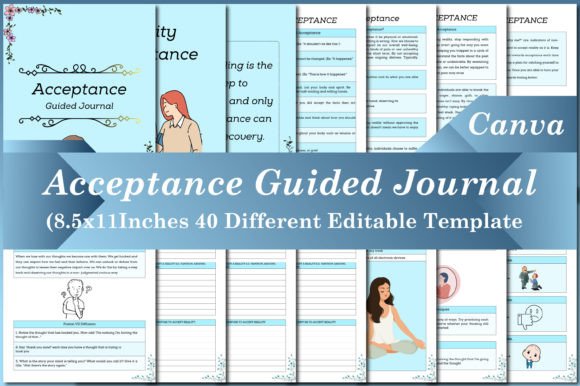
At its core, the Acceptance Guided Journal Canva Template is a digital product that gives you a complete 30-page guided journal structure. Inside, you find an editable Canva link and a ready-to-upload PDF file. The content isn't a pre-filled diary but a thoughtfully organized set of exercises rooted in acceptance and commitment therapy (ACT) and related self-reflection practices. Each page functions like a prompt or worksheet, covering topics such as acknowledging accomplishments, practicing reality acceptance, and identifying personal values.
Because the file is built for Canva, you can customize colors, fonts, and layouts before printing or using it as a Kindle Direct Publishing (KDP) book. The design assets—300 DPI, CMYK color, no bleed, 8.5 x 11 inches—are deliberately chosen to meet Amazon KDP standards, which opens up both personal and small-business use cases. Whether you want to create a single copy for yourself or format a low-content book for sale, the template serves as a foundation rather than a finished product.
What’s Inside the Template Layouts
Instead of blank pages, the template bundles multiple exercise styles under one roof. You’ll encounter worksheets labeled:
- Checklist – Acknowledge Your Accomplishment: A structured way to note recent wins, shifting focus from what’s missing to what’s already there.
- Reality Acceptance (two variations): Pages that guide you to face a situation exactly as it is, without minimizing or exaggerating.
- Self-Care Ideas: Prompts to brainstorm and commit to restorative actions, not just generic tips.
- Cognitive Diffusion: Exercises that help create distance from unhelpful thoughts, a core ACT skill.
- Acceptance And Commitment Therapy overview: A brief grounding in the ACT framework for context.
- Observing Surroundings: A mindfulness-based page encouraging present-moment awareness.
- Self Acceptance: A dedicated space to explore self-compassion and personal growth.
- The ACT Hexaflex: A visual model covering six key processes of psychological flexibility.
- Emotional Acceptance: A worksheet that normalizes feeling difficult emotions without struggle.
- Dropping Anchor: A grounding technique often used in turbulence, translated into a journalable format.
- Your Values / Values Bullseye: Activities that clarify what matters most and assess how closely your current life aligns with those values.
- Calendar 2024: A yearly overview page that can be edited to any year.
This mix addresses both the “acceptance” half and the “commitment” half of the framework. The pages don’t operate in isolation; when used together, they build a coherent progress path that moves from noticing and accepting internal experiences to taking values-guided action.
How It Compares with Other Guided Journal Formats
When evaluating the Acceptance Guided Journal Canva Template against other options, it helps to look at the broader category of journaling resources. The market includes pre-printed guided journals sold in stores, printable PDFs with fixed designs, generic Canva blank templates, digital journaling apps, and therapist-developed workbooks. Each comes with its own tradeoffs.
A physical guided journal offers immediate tangibility—no printing, no editing. But it’s rigid. You can’t remove pages you dislike or add your own exercises. The Acceptance Guided Journal Canva Template occupies the opposite end of that spectrum: maximum flexibility, zero pre-assembly. You decide what stays, what changes, and whether it becomes a spiral-bound notebook or a KDP interior.
Compared to standalone PDF templates that can’t be edited, a Canva-based source file puts design control in your hands. You aren’t locked into a color scheme or font pairing that doesn’t match your brand or preference. That matters if you’re a coach, therapist, or content creator who wants to add your logo and voice. On the other hand, a simpler non-editable PDF requires no design software learning curve; you print and go. The Acceptance Guided Journal Canva Template assumes you’re willing to open Canva (free or pro) and make a few tweaks.
When placed beside digital journaling apps, the template leans toward paper or paper-like use. Apps provide convenience, search, and portability, but many users report that handwriting exercises enhance emotional processing. This template supports that tactile depth while still allowing digital fill-in via a tablet and stylus if you choose to export pages as image files.
In relation to therapist-originated workbooks, the template isn’t a replacement for clinical guidance. It includes evidence-informed concepts but lacks the progressive chapters and professional insight of a published therapy workbook. However, for someone who understands ACT basics or works with a practitioner, the template fills a complementary role—a customizable tool for between-session reflection or self-study.
Key Strengths and Where It Shines
The design clarity is a standout. Commercial print standards (CMYK, 300 DPI, no bleed) are already baked in, which removes the guesswork for KDP uploads. The 8.5 x 11 inch size is an Amazon-friendly trim, and the 30-page count aligns well with low-content book expectations without feeling padded.
Another strength is the thematic cohesion. Rather than offering a random assortment of journal prompts, the template anchors itself in acceptance and commitment therapy. The inclusion of the ACT Hexaflex, cognitive diffusion, and drop anchor exercises speaks to someone familiar with these approaches and looking for a practical way to integrate them into a daily or weekly routine. Even a newcomer can benefit from the scaffolding: the exercises naturally teach key acceptance principles as they are completed.
For content creators, the editable Canva link turns a single purchase into a reusable asset. You can translate the text, swap out the 2024 calendar for any year, or redesign pages to match different niches (for example, a version adapted for new parents or for stress at work). This versatility is rare in pre-made journal interiors.
Where the Template Might Fall Short
Flexibility can also be a friction point. Users who expect a “download and print immediately, no adjustments needed” experience may find the Canva editing step unnecessary if they like the default design. While navigating Canva is straightforward for many, it’s still an extra platform login and a small learning curve.
The fixed page count of 30 is both a benefit (concise) and a limitation. Someone seeking an exhaustive 90-day journal or a deep-dive workbook might outgrow the template’s scope. Conversely, those wanting a very brief check-in system might find 30 pages more than they need. The no-bleed specification also means images or colors won’t extend to the edge of the page; that’s intentional for KDP compliance but may look less polished to print-at-home users who prefer full-bleed designs.
The calendar page is pre-labeled 2024. While it’s editable, the presence of a single year might confuse users who expect a perpetual calendar. It’s a small detail that can be updated, but it signals that the template was designed around a specific publishing moment. Additionally, because the content leans heavily on ACT, it won’t resonate with everyone. People looking for a more general gratitude journal, a bullet journal framework, or a cognitive-behavioral therapy (CBT) structure might need to look elsewhere or be comfortable heavily modifying the pages.
When This Template is Likely the Right Fit
Several scenarios align well with choosing the Acceptance Guided Journal Canva Template. If you are a coach, therapist, or workshop facilitator who wants to hand out personalized journaling materials without commissioning a designer, the editable link becomes a low-cost way to create branded tools. The ACT-based approach also fits seamlessly into practices that already use mindfulness or values clarification.
Another strong fit is the KDP author who wants to publish a low-content book quickly. Since the files are already tested for Amazon KDP standards, you avoid common rejection reasons like low resolution or incorrect trim size. The one-time purchase model means you can reuse the template across multiple interior designs as long as you respect the license, though always check the seller’s terms.
Self-directed learners who resonate with acceptance work and prefer pen-and-paper reflection will find the template offers just enough structure without dictating every thought. It’s particularly useful for those who have previously used blank notebooks but felt directionless. Here, each page has a clear purpose: accept reality, defuse from a sticky thought, then choose a small committed action.
Situations That Might Call for a Different Option
If you want a fully audible or app-based experience, a digital journaling platform with reminders and multimedia integration would serve better. Similarly, if you never plan to edit the design and prefer a physical product that ships to your door, a pre-printed guided journal on Amazon (using a similar ACT theme) might save time and effort.
People who are in acute psychological distress or working through trauma should approach any self-help tool with caution. The exercises in the template can be helpful adjuncts, but they aren’t monitored by a professional and lack the safety planning of a clinically developed workbook. In such cases, a therapist-recommended resource or direct clinical workbook is the more appropriate path.
Additionally, users who dislike any design work at all might find the Canva requirement a hassle. Even though the editable link is convenient, it’s still an extra step compared to a static, print-ready PDF that requires zero modifications.
Practical Ways to Get the Most from This Resource
If you decide to use the Acceptance Guided Journal Canva Template, consider these approaches to maximize its value:
- Customize the calendar year first. Even if you keep the design identical, updating the year prevents confusion and extends the template’s lifespan.
- Print a test page before ordering a full batch. Confirm that colors look correct on your home printer or that a print-on-demand proof captures the no-bleed margins properly.
- Use it as a supplement, not a standalone program. Pair the journal with an ACT self-help book, an app like ACT Companion, or sessions with a therapist for a richer learning experience.
- Add your own “instructions” page. If you’re giving the journal to clients, a brief front page explaining how to use each tool grounds the exercises in their real-world context.
- Adapt the intensity. Some days you might fill an entire Reality Acceptance page; other days, you might simply read the prompt and jot one line. The template doesn’t enforce a pace.
Making an Informed Decision Without Overthinking
The Acceptance Guided Journal Canva Template sits at a unique intersection: it’s a low-content book interior, an ACT-informed workbook, and an editable design asset all in one. Its primary advantage is the freedom to mold it to your context, whether personal journaling or commercial publishing. That same freedom becomes a drawback if you need a zero-effort, out-of-the-box solution.
Before committing, clarify your end goal. Do you want a physical journal that reflects your voice, a product to list on KDP, or a resource to enhance your professional practice? Does the ACT foundation align with your worldview? Answering these questions helps determine if the editable approach and the acceptance-based structure match your needs. The template isn’t a universal answer, but for those who value design control, evidence-informed content, and the ability to print or distribute with confidence, it provides a solid platform that can evolve with you.